Monday, 8 October 2012

Adults in children's play

In  a previous post  I spoke of the importance of play as a means for children to learn about their world, about relationships and about values.

But do you play with children, or supervise children while they play?

What is the difference?

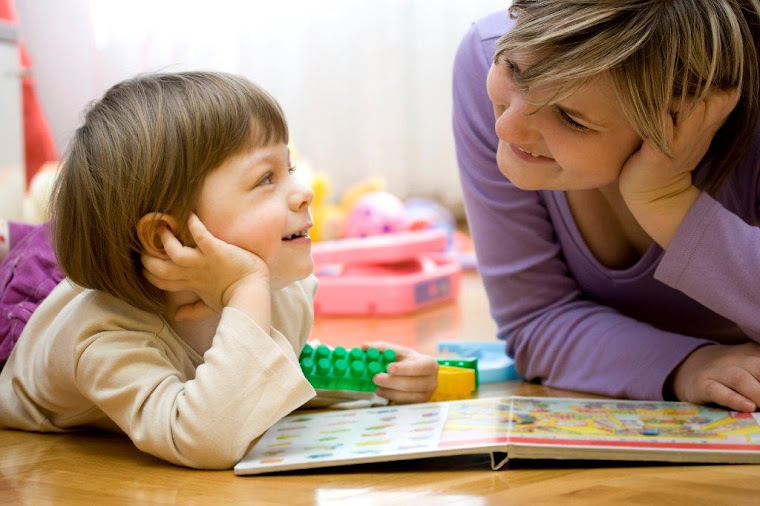
Playing with children means entering their world, engaging with them as they play, as a companion and fellow playmate.

Supervising children as they play means staying on the outer, observing and intervening when necessary so that participants have turns, resources are shared and safety is ensured.

I often hear parents say that their children have lots of toys but they rarely play with them.

There might be a number of reasons for this.

The toys:
  • may not be appropriate for their age
  • may require two or more participants to be used meaningfully
  • may take too much time and effort to be put together to be played with.
The children:
  •  may not have learnt how to play, to relax and use their levels of skill and imagination for pleasure
  • may need adult attention and interaction to guide them.
 On the other hand, perhaps parents, nannies and carers can expect too much of children, expecting them to play quietly and independently for long periods, which some times can be rephrased as 'keeping themselves occupied'.

Some children are much better at independent play than others, and will lose themselves either alone or with a companion, in their own world of imagination or role play, with cars or blocks or dolls' houses, in the sand pit, in their bedrooms or all over the lounge.  These children do not need adult involvement in their play, but simply supervision if the play suddenly becomes rough, or unfair, often signs that it has lost its appeal.  And of course, adults may need to remind the participants about tidying up afterwards.  After the play period, it can be useful to ask the child(ren) about the activity and to talk about how they played and what they might want to do next time, as well as an appreciative comment on the way that they played eg thoughtfully, imaginatively, quietly or whatever is appropriate.

Other children are more sociable and like to engage another person, child or adult, in their play.  For these children in particular, it is necessary for adults to learn how to participate, engaging in both the play and also ensuring that turns are taken, resources are shared and all are kept safe.  This is a case of simultaneously acting like a child and an adult, and is a valuable skill to learn.


In this type of play, as a participant the adult can often draw out from the child(ren) responses that will increase the learning value of the play: counting the number of pieces, commenting on their colours, sizes and shapes, but not to the detriment of the child(ren) having fun.  Again at the end of the play period, it is useful to make appreciative comments on the way they played.

Some facts for adults to learn about play include:
  • Play with out some mess and untidiness not real play. Tidy up before starting a new activity.
  • Children only have relatively short attention spans.  Watch for signs of restlessness and move on to another activity.
  • Play is a preparation for life.  The child does not always have to win, nor does the biggest always have to get his or her own way.
  • Play has to be fun and enjoyable.  If it's not fun, it's not play.
We often post play activities, and links to websites with play as their focus on our Facebook page.  Follow these links and you will be enriched in your play with children, and your supervision of children's play.


Saturday, 29 September 2012

Helping and caring...new dirty words?

As a society we seem to have mixed views of helping and caring.  We admire those who care for their elderly parents or disabled children, yet we also label as 'do gooders' or even 'busybodies' people who take on these and other, broader, roles in the community.  We urge our children to help each other, and yet the traditional helping professions like nursing, child care (and nannies) and social work tend to be seen as low status, poorly paid and traditionally, the domain of women.  In fact, men in these professions frequently are found in management rather than directly involved 'at the coal face.'

Recent moves to have those working in child care re-defined as 'early childhood educators and carers', while justified as better describing their role, seems to me to be undervaluing their role as carers. Perhaps being educators will improve their status, though probably not their wages and conditions.

What concerns me is that 'helping' and 'caring' seem to have become dirty words.  We have the expression 'nanny state' that denigrates both nannies and governments that legislate to try to protect people from their own folly eg the current move of some cyclists to abandon wearing crash helmets.  I have heard of young people applying to do social work courses being told that wanting to help people is not an adequate motivation.  Personally,  I can't think of a more important reason.

As a community, we depend on volunteers, helpers and cares, in many areas. The Australian Bureau of Statistics gives a breakdown of the role volunteers play in our society.  We value the work of bodies like the Country Fire Authority, SES, lifesavers and sporting clubs. Often these are now finding it necessary to have paid workers to supplement their volunteers.  Other areas which have depended on volunteers in the past are now experiencing chronic shortages when it comes to areas like foster care, Interchange (respite for children with disabilities), Big Brothers Big Sisters (mentoring for young people).  

I suspect too, that we tend to be prepared to help someone who falls in the street, but not if there is a whiff of alcohol, or they look unkempt or we suspect drugs might be involved; we might buy the Big Issue, because the sellers are helping themselves but bypass the homeless person who begs in the street.  We are reluctant to get involved if people are shouting or appear to be mentally disturbed, not even ringing for assistance.  I was interested when I came to the aid of a young man having a fit at the station, that most people just watched what was happening.  While there are occasional reports of heroes assisting in such circumstances, sometimes being hurt and even killed themselves, most people will just watch or go on about their own business, not even ringing the police.

Certainly, there are times when helping and caring can smother people, devalue their own efforts, and increase their dependency.  This is why we encourage parents to let children face situations that are a little difficult for them to manage easily, to teach children how to solve problems they face, to gradually take responsibility for themselves as they develop skills and maturity.  At the same time, however, we also need to acknowledge times when they simply need help or care:  when they are unwell, when they become so tired or frustrated that they lose their usual ability to think or act for themselves, and when they are in immediate danger.  

We encourage our children to help us in tasks around the house, in clearing up after play, in bringing a nappy to change the baby,  we are teaching them that helping is important, that there are tasks that need to be done for the good of all, that there is always something we can do. We also need to continue to foster in our children a sense of care for each other, not just the older for the younger, but the stronger for the weaker, the more able for the less able.  We need to teach the value of sharing, of including others in our play and in our world, and as they age, the importance of sharing what we have with those who have little or nothing.

Perhaps it is time to stop and think what we really value as a country and to give a higher status to those whose role it is to help other people, and to care for each other.  In this way we can all contribute to the well being of our community, our country and our world.


Monday, 17 September 2012

Safe Pedestrians: parents, nannies and their children

Imitation might be the sincerest form of flattery, but there are times when it can be a parent's or nanny's nightmare.

The odd expletive or a frank, unflattering comment is repeated; a gesture used; a behaviour copied....these are embarrassing, or cute, but sometimes, the behaviours in particular can have nasty consequences.

Who watched as you dashed across the road to post a letter, or dodged between cars on your way to the supermarket, or didn't stop at the red light  or didn't wear your seatbelt because it was only a short trip or talked on the mobile phone while driving?

What did these impulsive behaviours of yours teach an impressionable child?
  • to take risks when crossing the road or in the car
  • to disobey the law.
YOU are your child's role model as a pedestrian, as a passenger and as a driver.

YOU are old enough to know safe practices and to follow them carefully.

Last week we looked at safe procedures in the car, but pedestrian safety is also important.

How then do you teach a child to be safe as a pedestrian?
Many authorities believe that is not until children are aged 10 to 12 that they have the understanding, skills and experience to cope with traffic, including this Monash University study.

  • Insist that your toddler and young child holds your hand at all times when walking in the streets.  The only safe alternative to holding hands is to use a stroller.
  • Practise stopping at driveways and cross streets to check if cars are coming, especially emphasising that cars can be reversing and so often the driver cannot see them.
  • Choose safe places to cross the road, ie where you have a good view of the traffic in all directions.  It is often easier to get a good view mid-block rater than at a corner where you may have to look behind as well as ahead and sideways, because of turning traffic.
  • Cross the road at marked crossings where available eg school crossings (with the flags out), pedestrian crossings and at traffic lights.  Where pedestrian signals are available, only cross when the light is green.  Even at these regulated crossings, don't cross while there are moving vehicles.  As children get older, encourage them to participate in the decision making.
  • Teach the fourfold process: STOP, LOOK LISTEN and THINK. and go out often with your child(ren) to practise these skills.
  • When getting children in and out of the car, always use the kerbside door.
  • In car parks, there is often no kerbside door, but continue to use the same passenger door. By using safety locks in your car, do not allow the child(ren) to leave the car until you are there to open the door for them.  Remove and place in a stroller any infants, then the older child(ren) can get out.  Once out, check, with the children, for moving vehicles from all directions.  The recent tragic death of a young boy, chasing a football into a car park underlined the dangers there, as he had checked for cars on the way to pick the ball up, but ran straight under a car on the way back.
The other area to consider is ensuring that toddlers and young children cannot 'escape' from the house unsupervised.  Check gates and front doors are locked or secured with childproof locks to contain the wandering toddler and to give older children a moment to collect their thoughts before they go off.

It is probably not possible to prevent all road accidents involving children, but by setting a good example, by teaching children safe practices, and by limiting their unsupervised exposure as pedestrians until they are 10 to 12 years old, it is possible to minimise the risk.

Useful links:

Factors associated with ability to cross roads safely, Monsh University Study

A Child's World of Traffic , a VicRoads Video.


Sunday, 9 September 2012

Children, nannies and cars

As a parent, grandparent and as the  director of a nanny agency, the safety of children in cars and using the streets is especially important.


My particular concern is that nannies are frequently required to transport children as part of their role: to and from school, to play activities, to appointments etc.

As an agency, we have strict requirements about nannies driving, and the agency must be notified if transport of children is required before commencement of care.

It is the client's responsibility to ensure that the nanny has a driver's licence and that any car used has the necessary child restraints fitted, and is in a condition suitable for the transport of children.  If the nanny has any doubts about these areas, we recommend that they raise their concerns with the client families, and if this does not make any difference, with the agency, and that they should not drive until the issues are resolved.

In Victoria, the law requires all adults, driver, front and back seat passengers to use a seat belt.  As at February, 2012, all children must be properly restrained according to the following requirements:
  • Children under 6 months to be in a properly fastened and adjusted rear facing approved restraint , generally a reclined baby car seat;
  • Children 6 months to under 4 years to be in a properly fastened rear OR front facing approved restraint with inbuilt harness;
  • Children aged 4 years to under 7 years to be in a properly fastened and adjusted forward facing approved child restraint with in built harness OR  or a properly fastened and adjusted lap-sash belt or child safety harness;
  • Children aged 7 to under 16 years to be in an approved booster seat with a properly adjusted lap-sash belt or child safety harness OR a properly fastened and adjuted seatbelt. An adult lap-sash belt is designed for a minimum height of 145cm., a height most children reach between 10 and 12 years.
  • If a car has 2 or more rows of seats, children under 4 must not travel in the front seat;
  • If all rear seats are used by children under 7, children aged 4 years and under 7 may travel in the front seat, provided they use an approved booster seat.
  • Any child too heay or too tall for the restraint recommended for their age should use a restraint in the next age category.
Note that  the emphasis is not only on the appropriate type of restraint, but also on proper fastening and adjustment.  For this reason, it is recommended that restarints be fitted at an approved fitting station, and that you check regularly that the restraint is still the right size for the child, and that all the connecting straps are done up firmly.

All this information, and advice on approved restraints and the location of fitting stations is available from Vicroads and in brochures available from the Victorian Government bookshop.

Beyond these formal requirements, we expect that nannies use good safety procedures. These include:
  • Always put children in and out of the car by the kerbside door;
  • Put the older child(ren) in the car, then transfer the baby from its pram/stroller, then put shopping etc in the car;
  • When leaving the car, get out and assemble the pram/stroller then get the baby out, followed by the older child(ren);
  • Do not allow the older child(ren) to open the door or to leave the car until you are at the exit door; this is easily avoided if you use the childproof door locks provided by most manufacturers;
  • Have the windows closed with lock on, or if necessary in hot weather, only have the windows open for 4-5 cms at the top;
  • Insist on quiet behaviour in the car, and if there is any squabbling etc, stop the car until the behaviour stops.  On long drives, use distractions like familiar songs and stories on CD/DVD or if necessary videos, but preferably looking out the window spotting things, playing I Spy.  The purpose of all this is to reduce distractions for the driver;
  • NEVER leave children unattended in a car.
Road safety is a huge area, and in another blog we'll look at pedestrain safety and teaching children good practices.

Links:

Monday, 3 September 2012

5 tips for managing your expectations of motherhood

This week's guest blogger is Dr. Melanie Strang, a Melbourne doctor and mother with an interest in antenatal education and in emotional well being during and after pregnancy.

She runs a program called Well Mum Well Baby with the aim of providing "Emotional, Psychological and Relationship Preparation for New or Expectant First Time Parents."

Melanie's work in preparing parents for the life-changing event of the birth of their first child, is aimed at helping understand what is happening and thus help maintain emotional health during this happy but stressful time.

Here are her 5 tips for managing expectations of pregnancy:


Be flexible: It is common for mums to struggle with coming to terms with what they planned versus what reality serves up. For example you may have planned to return to work by 3 months yet circumstances change when bub arrives.

Don’t believe the hype: The media portrays a romanticized version of motherhood: Understand that life with a young baby does not look like a Huggies ad! There are amazing moments of joy and bonding yet this is mixed with plenty of dirty nappies, hard work and acclimatising to this massive transition.

Love takes time: Bonding with your baby may not happen immediately: It is normal for bonding to occur over a period of weeks to months. If a baby has a medical illness bonding may take longer- this may not be in line with your expectations but it’s ok.

It ok to be sad: There are many losses associated with motherhood: Having a baby is a time of wonderment and joy but acknowledging the losses will help you move forward-you are now a different version of yourself.

There are no rights and wrongs: No one bit of advice or parenting book will have all the magic answers- you and your baby are a unique pair to be understood in your own right.

 Useful links:

 Well, Mum, Well Baby


Maternal and Child Health Service in Victoria, reference for the free, univerally available service in Victoria, Australia

PANDA, for support with postnatal depression

Breastfeeding Australia for support with breastfeeding


Saturday, 25 August 2012

Raising healthy boys!

I love little boys, but I can understand that some mothers recoil in horror when they find that there lovely baby boy:
  • is fixated on cars and all forms of wheeled transport
  • takes great joy in loud burps and farts, often repeated for extra effect
  • runs and climbs and kicks and throws balls
  • is unable to sit quietly without starting to wriggle, wrestle with siblings and create a commotion
  • plays superheroes and has mock fights at every opportunity
It's not that little girls don't do these things, but somehow, some little boys do them all and with such gusto.
And it's not as if every little boy is like this.  Some are gentle, sensitive souls who are creative, studious and caring.
But some little boys are right out there, almost as a caricature of all that is masculine.

Parents of children like this should not despair, even as these youngsters challenge their rules and push the boundaries.

These little boys are healthy.
  • They are often physically assured and so challenge what we regard as safe behaviour.  A tree is there, so climb it.  A fence is there, so balance on it.  They are confident in their own abilities and consequently take risks so they end up bruised, scratched and sometimes with broken limbs.
  • Their personalities tend to be irrepressible and they take little notice of warnings, especially from those they regard as having inferior prowess (ie their mothers).  
  • They tend to be cheerful, not brooding; they are given to hero worship of those bigger and stronger.  
  • And they are often very affectionate when they are not being thoroughly obnoxious.

Raising healthy young boys, however, does require that they have good male role models.  This is especially true when they live in all female households, or where their fathers are present but frequently absent because of work, or are emotionally absent.

They need male figures in their life who can match their energy and help to channel this into safe and fun activities.

They need to learn from these figures:
  • that people who don't share their enthusiasms are different but still worth having as friends.
  • that there is a time and a place for their more boisterous behaviour, but there are also times when it is sensible to be quieter
  • that there are limits which need to be observed for the safety of others, if not themselves
  • that their behaviours do have consequences.

It is important to have rules about:
  • respecting other people eg no bullying, good manners
  • the difference between indoor play and outdoor play eg no jumping on the furniture or running inside
  • the difference between inside and outside voices eg quieter voices inside

But the quiet, sensitive boys also need good male role models who can show how these qualities can be expressed without leaving the boy open to mocking or bullying.
They need to know that it is ok for boys to be artistic and creative, that not every boy is a future footballer.
While their more boisterous brothers are climbing trees and leaping from rock to rock it is fine for them to be collecting flowers to draw, or watching the clouds blow and making up stories about the images they can see or playing 'Pooh sticks' (floating sticks from one side of a bridge to another in the style of Winnie the Pooh.)

And boys need male role models to show them how to be decent adult men, respectful of women, respectful of property, and respectful of themselves so they don't drink themselves to oblivion, use drugs or drive dangerously.

Boys are fun, but they need lots of help to grow up healthy.


Saturday, 18 August 2012

Nanny power!

It is an honor to present our first guest blogger, Tracey McDermott. Tracey is a very experienced nanny who has received much publicity recently for her efforts to promote the status of nannies: a wonderful example of a movement by nannies for nannies.

Here's her story.

 
I have always loved babies and children. One of my hobbies as a child was collecting pictures of babies and books about babies, so it is no surprise that when I decided to pursue a career that would bring me joy rather than just a pay check, childcare was my first choice. I started out in long day care centres. When the opportunity to relocate to London and become a nanny presented itself, I grasped it with both hands. My time in London convinced me that being a nanny was the perfect career for me and I have continued to work as a nanny since my return to Australia.

Nannies are a more socially accepted form of childcare in England than they are in Australia and I have found that the work of nanny is largely misunderstood here. I often have to explain to curious people that I do have a qualification; I don’t clean the houses I work in, nor do I cook the parents' dinner or do various other household chores. 

 Most of the nannies I know have an early childhood qualification and provide excellent quality care for the children they are employed with.  They take the children on outings, provide educational activities at home and have play dates with other nannies and children. They care for the children when they are sick, patch them up when they have a fall, read bedtime stories, repair holes in much loved teddies, climb into pig pens to rescue toy giraffes (yes, I actually did that!), and do things like cook dinosaur shaped pasta to make dinnertime fun! 

                                               
                                                           A morning at the park.


The benefits of the close relationship that develops between a nanny and the children should not be underestimated either. I am proud of being a nanny. I think what we do is invaluable and important not only for the lives of the children in our care, but for the parents we work for as well.                  
                                       
When an article (http://www.theaustralian.com.au/national-affairs/learning-crucial-to-childcare-coalition/story-fn59niix-1226330778697) appeared in The Australian newspaper earlier this year claiming that extending the childcare rebate to nannies would put children in the care of unqualified babysitters, place them at risk and see them well behind their peers, I was infuriated. The article went on to claim that nannies have no childcare qualifications, or are only trained to babysit, unlike childcare centres where staff members are university educated. As often happens, nannies were categorised as unskilled ‘babysitters’ rather than professionals with qualifications.

I wrote to the journalist to set her straight and defend the many great nannies working in Australia, asking her to write another article addressing the false claims about nannies and she agreed. http://www.australiannannyassociation.org/index.php/media-room/9-nannies-fight-back-over-glorified-cleaners-stereotype 
The feeling that nannies were misunderstood and undervalued here was now something more real and I wanted to do something about it. With a few other women from the industry who were equally upset by the article we started the Australian Nanny Association. The troops were rallied and we now have almost 190 interested people waiting for the opportunity to join up as members.

I see one of the roles of the association in the future (and the one I am most passionate about), as being one of educating the public in an effort to change the perception of nannies as unqualified babysitters and cleaners for the privileged. I hope that one day Australian society will understand and value the work we do, as much as we do. It’s a big dream, but I’ve never been one to dream small.

Another important role I hope the association will play is to connect nannies from across Australia in one place for building friendships, sharing information and supporting each other.

The Australian Nanny Association can be found at 
http://www.australiannannyassociation.org/
And we hope to be taking memberships by the end of August.


                                          Making dinosaur footprints at home.